
Introduction
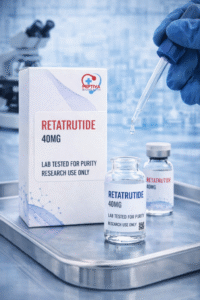
Retatrutide is one of the most talked-about research peptides in recent years, gaining attention in scientific communities for its role in metabolic and multi-pathway research.
As interest grows, researchers are increasingly exploring how compounds like Retatrutide behave in controlled laboratory environments.
What is Retatrutide?
Retatrutide is a multi-receptor research peptide studied for its interaction with key metabolic pathways.
It is often described as a:
- Triple-agonist compound
- Targeting multiple biological receptors involved in energy regulation
In laboratory settings, this makes it a valuable compound for studying complex biochemical interactions.
How Does Retatrutide Work in Research?
In controlled research environments, Retatrutide is studied for its ability to interact with:
- GLP-1 receptors – linked to metabolic signalling
- GIP receptors – associated with energy balance
- Glucagon receptors – involved in metabolic regulation
This multi-pathway interaction allows researchers to explore:
- Compound synergy
- Receptor interaction dynamics
- Metabolic pathway modelling
Research Applications of Retatrutide
Retatrutide is used in laboratory studies to support:
Metabolic pathway research
Understanding how multiple receptors influence energy systems.
Compound interaction studies
Analysing how peptides behave when interacting with different biological targets.
Stability and formulation testing
Evaluating compound integrity under controlled conditions.
Experimental modelling
Supporting early-stage research frameworks and simulations.
Why Retatrutide is Gaining Attention
Compared to traditional single-pathway compounds, Retatrutide offers:
- Multi-receptor interaction potential
- Broader research scope
- Advanced modelling capabilities
This makes it particularly useful in next-generation peptide research.
Important: Research Use Only
Retatrutide, like all research peptides sold through compliant suppliers, is:
- Strictly for laboratory research use
- Not for human or veterinary consumption
- Used only in controlled scientific environments
This ensures alignment with UK regulatory expectations.
Storage & Handling Guidelines
To maintain compound integrity:
- Store at 2–8°C (refrigerated)
- Avoid exposure to heat and light
- Keep sealed until use
- Use only in controlled laboratory settings
Explore Related Research Compounds
You can internally link here (very important for SEO):
- NAD+ research compound
- GH-3 Complex peptide blend
- Other laboratory-grade research peptides
Conclusion
Retatrutide represents a new generation of research peptides, offering broader insight into complex biological systems.
Its multi-receptor activity makes it highly valuable for:
- Advanced laboratory studies
- Experimental modelling
- Biochemical research
As interest in peptide research grows, compounds like Retatrutide will continue to play a key role in scientific exploration.
Related Research Guides
For further reading:
– Learn more about research peptides in our complete laboratory guide
– Read our UK legality guide for research peptides